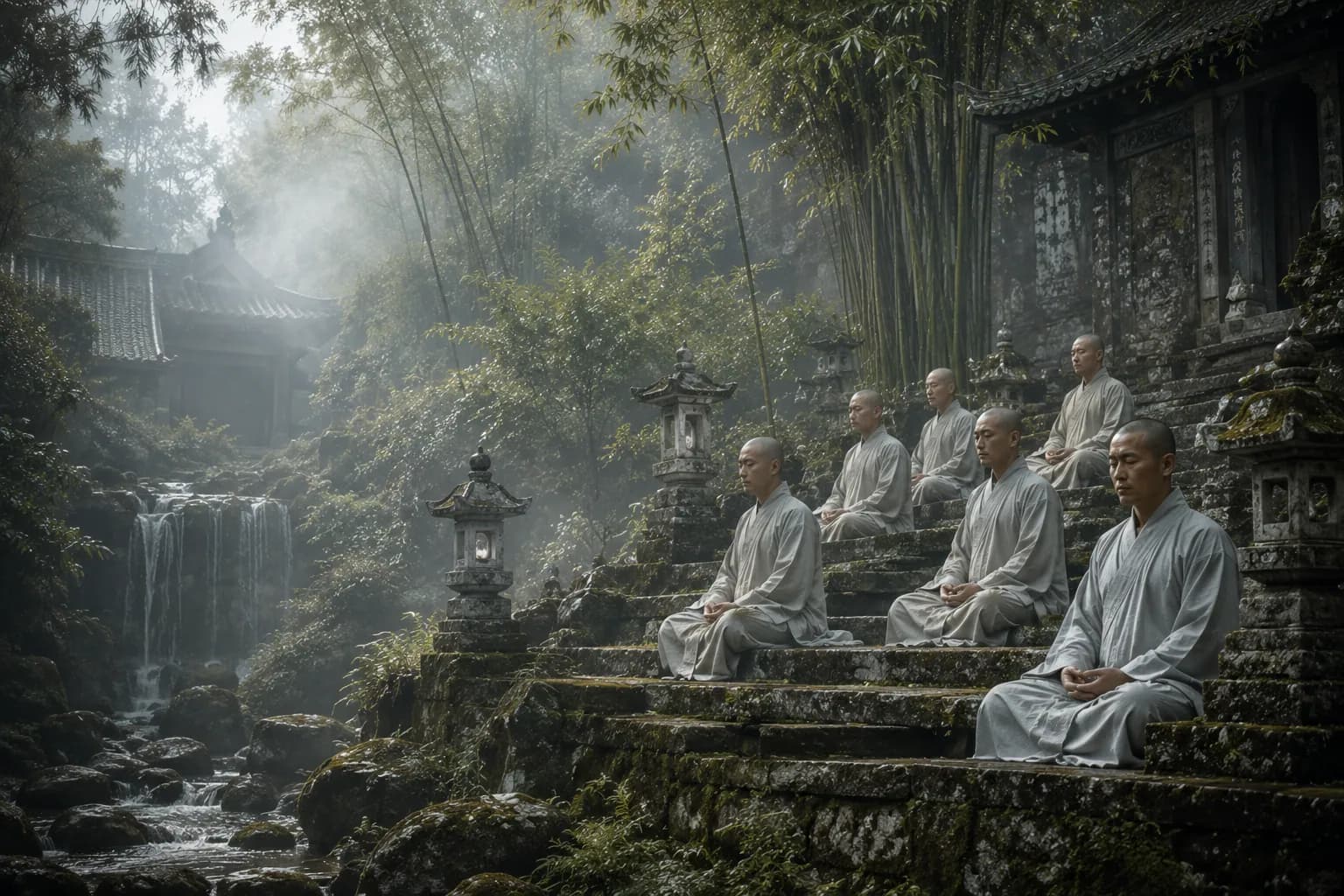
The water point at the back of the knee. Yingu (KI-10) is the He-Sea point of the Kidney channel — a point that clears Damp-Heat from below, benefits the Kidneys, and eases pain along the inner leg. Quiet and deep in character, like still water pooling in a valley.
Contraindications
No special contraindications are noted in the sources for this point. Standard clean needling technique and correct depth apply.
Name & story
The name 阴谷 Yingu means "Yin Valley". Picture a shaded valley — cool, sheltered, hidden from the sun — and you have the image this point carries. It sits in the soft hollow at the medial end of the back of the knee, tucked between two tendons like a stream finding its way through a gorge. The Yin side of the leg, the Kidney channel, the deep crease of the knee — all of these together make a true "Yin valley", a place where water naturally gathers and rests.
Point family & character
Yingu (KI-10) belongs to the Kidney channel (KI). It is the He-Sea point of the channel and, at the same time, the Water point — the element of the Kidney itself. This double identity — Water upon Water — gives it a concentrated, focused quality that is specific to clearing and benefiting the Kidney system at the level of the lower Jiao.
Five-element dynamics
The Kidney is the Water organ, and Yingu (KI-10) is the Water point of the Kidney channel — a meeting of Water with Water, the purest and most distilled expression of the Kidney's own element. In Chinese medicine, the He-Sea points are where the channel's Qi deepens and dives inward, like a river finally reaching the sea. At Yingu, that depth turns toward the Kidneys and the lower Jiao. When Damp-Heat accumulates below — clouding urination, inflaming the genitals, or disturbing the uterus — this point draws on Water's clarity to wash it away. And when the Kidney itself needs direct support, Water point speaks to Water organ in the most direct way possible.
Location
Find the crease at the back of the knee. At the inner (medial) end of that crease, feel for two prominent tendons — the semitendinosus sits more toward the back, the semimembranosus slightly in front. Yingu (KI-10) sits between them. To make the tendons stand out more clearly, ask the patient to gently tighten the hamstrings. Locate and needle with the knee slightly flexed.
Anatomy & fascia
The point lies at the medial end of the popliteal crease, between the tendons of the semitendinosus and semimembranosus muscles.
Needling
The needle is inserted perpendicularly, between the two tendons. The knee should be slightly flexed during needling.
Safe depth
1 to 1.5 Cun.
Functions
Clears Damp-Heat from the lower Jiao; Benefits the Kidneys; Activates the channel and alleviates pain.
Indications
Urinary difficulties: painful urination, urgent urination, dark urine, difficult or obstructed urination with pain radiating to the thigh. Genital complaints: impotence, pain of the genitals, itching of the scrotum, uterine bleeding, leucorrhoea, difficulty conceiving. Abdominal pain: hypogastric pain radiating to the genitals and inner thigh, periumbilical pain, abdominal distention. Diarrhoea. Shan disorder (cold-type hernial pain). Knee pain — especially a deep, drilling pain with restricted movement — and pain along the inner thigh. Manic disorders and mania-depression; protrusion of the tongue with drooling.
Mind & spirit (Shen)
Yingu (KI-10) carries a quiet but real influence on the mind. The Kidney in Chinese medicine is the root of the will — the Zhi, that steady inner drive that keeps us moving forward. When Damp-Heat disturbs the lower Jiao, the whole system grows agitated and restless. The sources also note its use in manic disorders and mania-depression — conditions where the mind has lost its anchor. By clearing what clouds the lower Jiao and settling the Kidney's water, Yingu helps restore the quiet depth that the mind needs in order to find stillness again.
Point combinations
Yingu (KI-10) is naturally combined with points that address the lower Jiao, the urogenital system, and Damp-Heat: it pairs well with local and distal points for urinary difficulty, genital pain, and knee disorders along the inner leg.
Clinical spotlight
What makes Yingu (KI-10) distinctive is its double identity: it is both the He-Sea point and the Water point of the Kidney channel — two qualities that converge here and make it the most direct point on the channel for clearing Damp-Heat from the lower Jiao. Deadman notes its specific usefulness for difficult, painful urination; genital pain and itching; hypogastric pain radiating downward; and — perhaps most strikingly — manic disorders with protrusion of the tongue and drooling, suggesting its reach into the Shen. Its location in the popliteal crease also gives it a clean structural action: deep, drilling knee pain with limited movement, especially along the inner aspect, responds well to needling here.
The golden tip
Yingu (KI-10) is a little harder to reach on oneself than points on the lower leg, but it is worth knowing. Sit with the knee slightly bent and feel for the soft hollow at the inner end of the back-of-knee crease, between the two tendons. Gentle pressure or massage here can help ease inner knee tightness and support the lower Jiao. As always with acupuncture points in sensitive areas, needling should be left to a qualified practitioner.
For education only — not medical advice. Consult a qualified practitioner.