A quiet but powerful point on the chest, Lingxu (KI-24) brings the Kidney channel's deep nourishing energy all the way up to the thorax — calming the heart, opening the chest and lifting a spirit weighed down by grief or anxiety.
Name & story
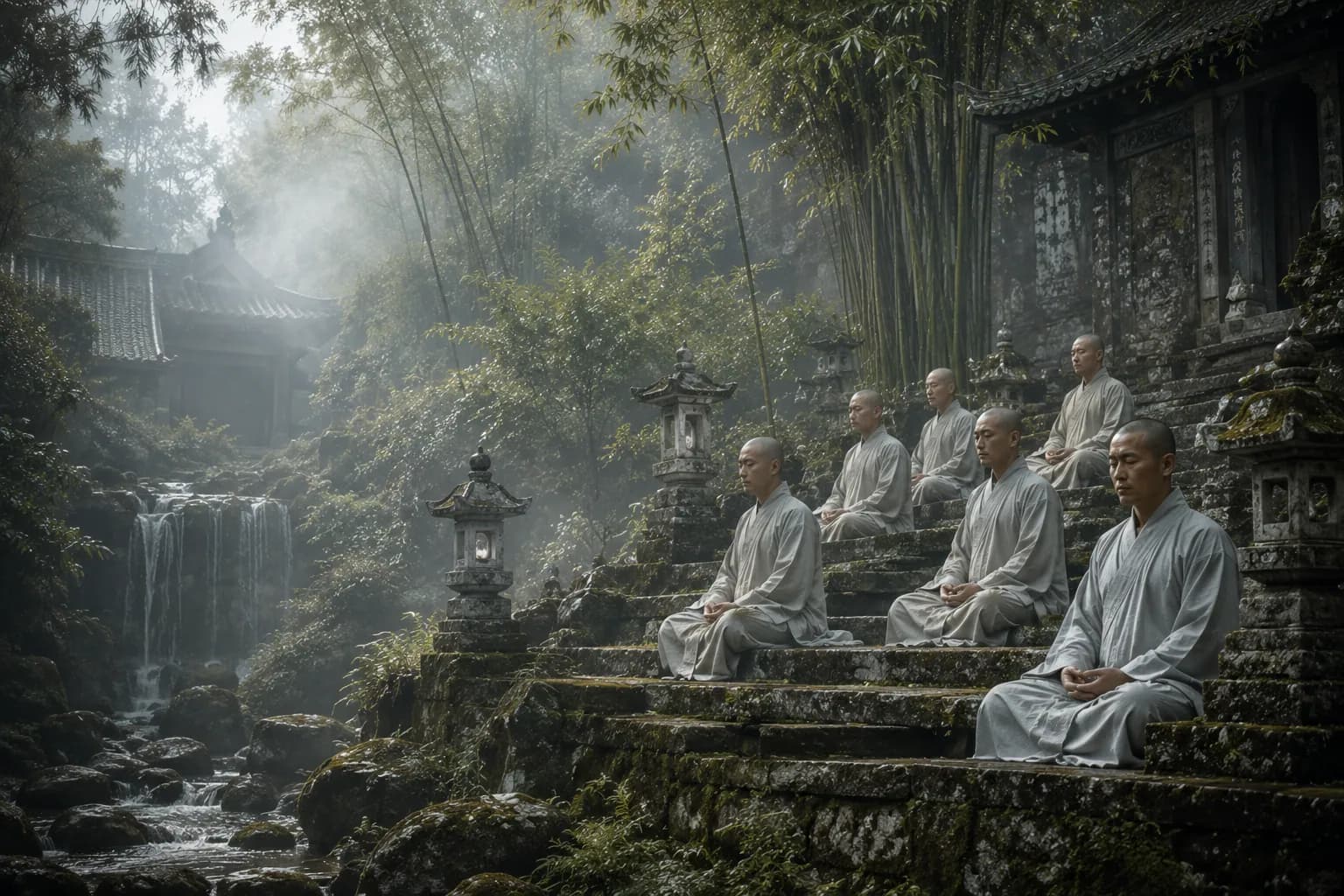
The name 灵墟 Lingxu is often translated as "Spirit Burial Ground" or "Spirit Ruin" — a hauntingly poetic image. 灵 (líng) means spirit, soul or the numinous; 墟 (xū) means a mound, a ruin, an empty hollow — the kind of place where something precious once rested. The name suggests a dwelling place for the Shen, the spirit — but one that has become hollow or sunken, like a space that needs to be filled again. To needle this point is, in a sense, to restore life to that emptiness, to re-invite the spirit back into its home in the chest.
Point family & character
KI-24 belongs to the Kidney channel (KI) and sits on the chest portion of the channel's pathway, where the Kidney meridian runs upward along the sternum. It has no special classical category such as Yuan Source or Xi Cleft, but its location on the chest — close to the Heart — gives it a natural affinity for calming the Shen and addressing disorders of the thorax and breast.
Five-element dynamics
The Kidney is the root of Water in the body, holding the deepest Yin and Yang. When the Kidney channel rises to the chest, it carries that cool, nourishing Water energy toward the Heart — the Fire organ that houses the Shen. At KI-24, this upward movement of Kidney Qi meets the chest, helping to moisten and calm, to counterbalance any Heat or agitation rising in the upper body. It is a meeting point, in a sense, of Water and the space where the spirit lives.
Location
KI-24 is found on the chest, in the 3rd intercostal space (between the 3rd and 4th ribs), 2 Cun lateral to the midline of the sternum.
Anatomy & fascia
The point lies over the pectoralis major muscle, in the intercostal space between the ribs.
Needling
The needle is inserted obliquely or transversely along the intercostal space. Care is taken not to needle too deeply, as the chest cavity lies beneath.
Moxa, cupping & Tui Na
Gentle massage or acupressure on this point can be very soothing — especially helpful for tightness and anxiety in the chest. Moxa is used with caution on chest points; indirect moxa (moxa stick held at a comfortable distance) may be applied when Cold or deficiency is present.
Functions
Unbinds the chest and descends rebellious Qi; Stops coughing and calms breathlessness; Clears Heat from the chest; Calms the Shen and eases anxiety; Benefits the breast.
Indications
Cough, breathlessness and fullness or tightness in the chest. Pain in the chest or lateral costal region. Nausea and vomiting when rebellious Qi rises upward. Breast pain, swelling or lumps. Difficulty swallowing.
Mind & spirit (Shen)
Because Lingxu sits so close to the Heart — right on the chest wall, near where the Shen resides — it carries a quiet power to settle a disturbed spirit. When grief or deep sadness has hollowed out the chest, when anxiety makes the ribcage feel tight and constricted, or when the spirit seems to have "gone quiet" and retreated, this point gently calls it back. The image in the name itself speaks to this: a hollow place in the spirit, waiting to be filled. Lingxu does not shout — it quietly restores.
Clinical spotlight
KI-24 is a lesser-known but clinically valuable point for chest complaints — particularly when the Kidney channel's nourishing influence needs to reach the upper body. Its location makes it especially useful for breast disorders and for the kind of chest tightness that comes with emotional suppression or grief. The evocative name — Spirit Ruin — reminds the practitioner that sometimes the most important thing this point does is not physical at all, but quietly spiritual.
The golden tip
To find KI-24, place your fingers on your sternum and move about two finger-widths to either side, then find the space between the 3rd and 4th ribs. Gentle circular pressure here — especially with slow, deliberate breathing — can help ease chest tightness and calm anxious feelings. It is a good point to rest your own fingertips on during moments of grief or overwhelm.
For education only — not medical advice. Consult a qualified practitioner.