Everything in Chinese medicine — every herb, every needle, every dietary tweak — flows from one thing: the pattern. In Traditional Chinese Medicine (TCM), you do not treat a disease so much as a pattern of disharmony, and identifying that pattern is the single most important act of diagnosis. It is the bridge that carries the theory of Qi, Blood, organs, and Yin–Yang into an actual treatment for an actual person.
What Is a Pattern?
A pattern (in Chinese, Zheng) is a snapshot of an imbalance — a coherent cluster of signs and symptoms that points to a specific disharmony at a specific moment in time. It is not the same as a Western disease name. A Western diagnosis asks what disease is this?; a TCM pattern asks what is out of balance, and in which direction?
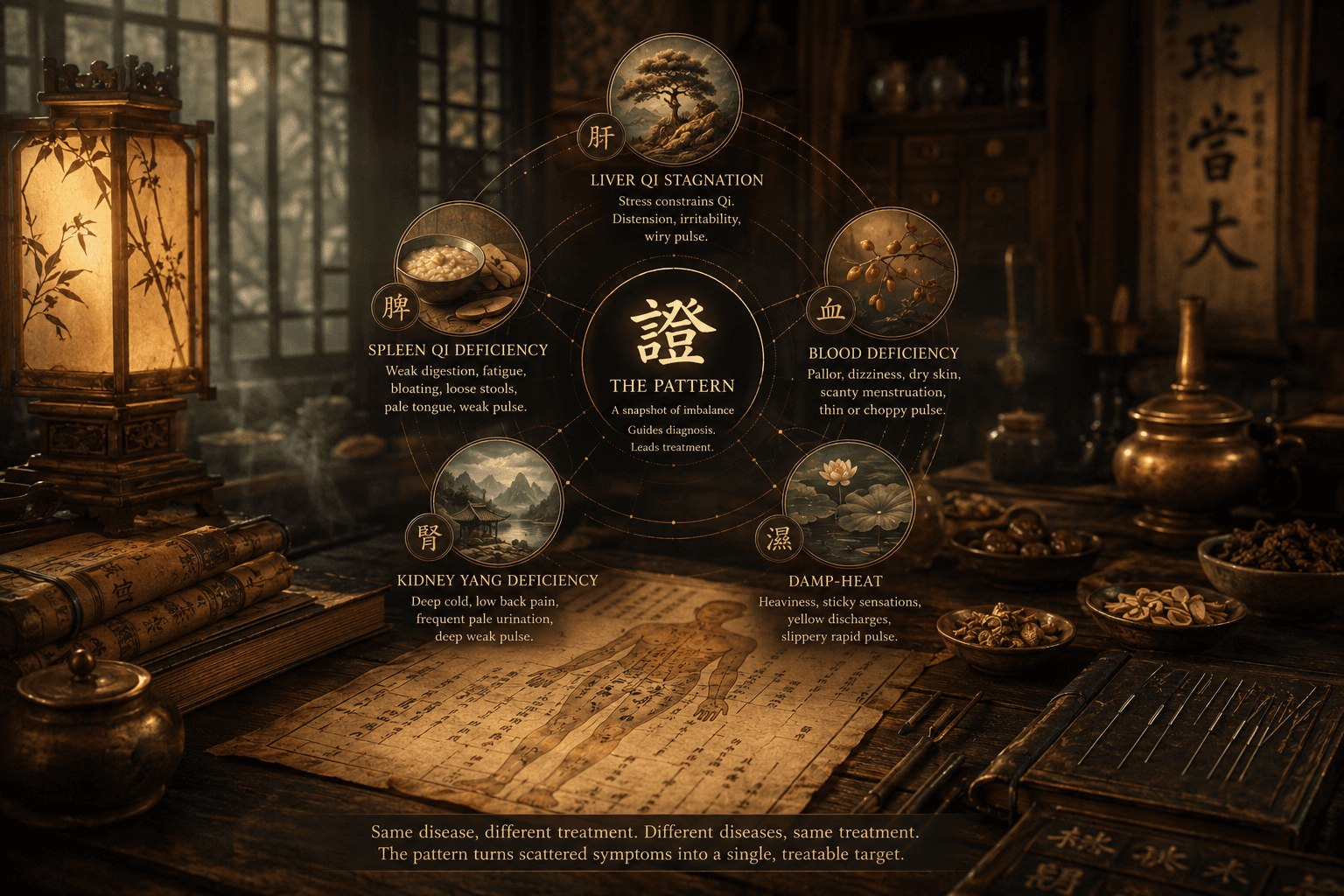
This difference has a famous consequence, captured in a classical saying: "same disease, different treatment; different diseases, same treatment." Two patients with migraines may carry entirely different patterns and receive different care, while a single pattern — say, Spleen Qi deficiency — might underlie fatigue in one patient, loose stools in another, and easy bruising in a third, all treated along the same lines. The work of identifying the pattern is called pattern differentiation (Bian Zheng), and it is assembled from the four examinations: looking (including the tongue), listening and smelling, asking, and palpating (including the pulse).
The Eight Principles: The First Sorting
Before naming a specific pattern, a practitioner orients themselves along eight guiding principles, arranged in four pairs:
- Interior / Exterior — where the imbalance sits: on the surface (a fresh cold) or deep in the organs.
- Cold / Heat — its thermal nature: is the person cold, pale, and slow, or hot, red, and agitated?
- Deficiency / Excess — whether the problem is too little (weak upright Qi) or too much (an active pathogenic factor or blockage).
- Yin / Yang — the grand summary that gathers the others: Yin patterns tend to be interior, cold, and deficient; Yang patterns exterior, hot, and excess.
This first pass orients everything that follows. A "cold, deficient, interior" picture and a "hot, excess, exterior" picture call for opposite strategies, even before the exact pattern is named.
Pattern: Liver Qi Stagnation
- Cause — emotional stress and frustration constrain the Liver's job of keeping Qi flowing smoothly.
- Signs — a feeling of distension or tightness in the chest, ribs, or abdomen; frequent sighing; irritability or low, changeable mood; premenstrual tension; sometimes a sensation of a lump in the throat. The hallmark is that symptoms fluctuate with emotional state.
- Tongue & pulse — tongue often normal or slightly purple; pulse wiry, like a taut string.
- Treatment direction — soothe the Liver and move the Qi, with Qi-regulating formulas, points such as Taichong (LV-3), and movement practices that keep Qi flowing.
Pattern: Spleen Qi Deficiency
- Cause — irregular diet, overwork, chronic worry, and excess cold or raw food weaken the Spleen's power to transform food into Qi and Blood.
- Signs — fatigue that is worse after eating, poor appetite, bloating, loose stools, a heavy feeling in the limbs, easy bruising, and a pale complexion.
- Tongue & pulse — tongue pale and swollen with teeth marks along the edges; pulse weak.
- Treatment direction — tonify the Spleen Qi and support digestion with warming tonic formulas, points such as Zusanli (ST-36), and a diet of warm, cooked, easily digested food.
Pattern: Blood Deficiency
- Cause — weak production (often a weak Spleen), blood loss, or long illness leaves the Blood unable to nourish and moisten.
- Signs — pallor of the face, lips, and nails; dizziness; dry skin and hair; blurred vision; poor memory; scanty menstruation; and difficulty falling or staying asleep, since the Blood no longer anchors the mind.
- Tongue & pulse — tongue pale and thin; pulse thin or choppy.
- Treatment direction — nourish the Blood with Blood-building formulas and points, while strengthening the Spleen that produces it.
Pattern: Kidney Yang Deficiency
- Cause — aging, constitution, chronic illness, or long overwork deplete the body's deep warming Yang.
- Signs — a deep, persistent cold, especially in the lower back, knees, and limbs; aversion to cold; low libido; frequent, copious, pale urination; weak or sore lower back and knees; and loose stools, often in the early morning.
- Tongue & pulse — tongue pale and wet; pulse deep and weak.
- Treatment direction — warm and tonify the Kidney Yang, where moxibustion and warming tonic herbs are central.
Pattern: Damp-Heat
- Cause — a diet heavy in greasy, sweet, or alcoholic food, a damp climate, or a weak Spleen generating internal dampness that then combines with heat.
- Signs — heaviness and a feeling of being unclean; sticky, sluggish sensations; yellow discharges; certain skin problems; burning or discomfort in the digestive or urinary tract; and thirst without a real desire to drink.
- Tongue & pulse — tongue red with a greasy yellow coating; pulse slippery and rapid.
- Treatment direction — clear the heat and drain the dampness, always alongside adjusting the diet that feeds it.
How Patterns Combine
Real patients rarely present one clean pattern. Patterns layer and interact. A weak Spleen often generates dampness, so Spleen Qi deficiency and dampness travel together. And one of the most common combinations of all is Liver Qi stagnation "overacting" on the Spleen — the Wood-over-Earth relationship of the Five Elements — producing digestive symptoms that flare with stress. The practitioner's task is to distinguish the root from the branch: which imbalance is primary and which is its consequence, and therefore what to treat first.
Why Patterns Matter
The pattern is what turns a scattered list of complaints into a single, treatable target. It is why two people with the same Western diagnosis can need opposite treatments, and why one TCM strategy can help several unrelated conditions. Every clinical case, every herbal formula, and every point prescription in Chinese medicine begins with the same question — what is the pattern? — and once you can hear that question inside a set of symptoms, you are thinking the way a Chinese medicine practitioner thinks.