Alongside acupuncture, herbal medicine is the second great pillar of Chinese medicine — and for internal and chronic conditions, often the more powerful. But its genius is easy to miss, because it does not live in any single herb. It lives in the formula: a combination of herbs engineered, like a piece of music, to answer a whole pattern. Understanding how formulas are built is the key to understanding Chinese herbal medicine at all.
More Than Single Herbs
Western herbalism often reaches for one herb to address one effect — chamomile to calm, ginger to warm the stomach. Chinese herbal medicine works differently. Because it treats a pattern — a multi-dimensional imbalance rather than a single symptom — it almost always uses formulas, carefully composed combinations of several herbs. The traditional materia medica contains hundreds of substances, mostly botanical with some mineral and animal, and each is described in a precise, consistent language before it ever enters a formula.
How a Single Herb Is Described
Every herb in the Chinese pharmacopeia is characterized by the same set of properties — the same information you will find on each herb's page in our knowledge base:
- Nature (temperature) — hot, warm, neutral, cool, or cold. Warming herbs treat cold patterns; cooling herbs treat heat. This is the first thing a practitioner checks.
- Flavor (taste) — pungent (disperses and moves), sweet (tonifies and harmonizes), sour (astringes and contains), bitter (drains and dries), and salty (softens and purges). Flavor is not just taste; it implies a direction of action.
- Channels entered — which organs and channels the herb targets, guiding its effect to the right part of the body.
- Direction — whether the herb tends to ascend and float outward, or descend and sink inward.
- Actions and indications — what it does and the patterns it treats.
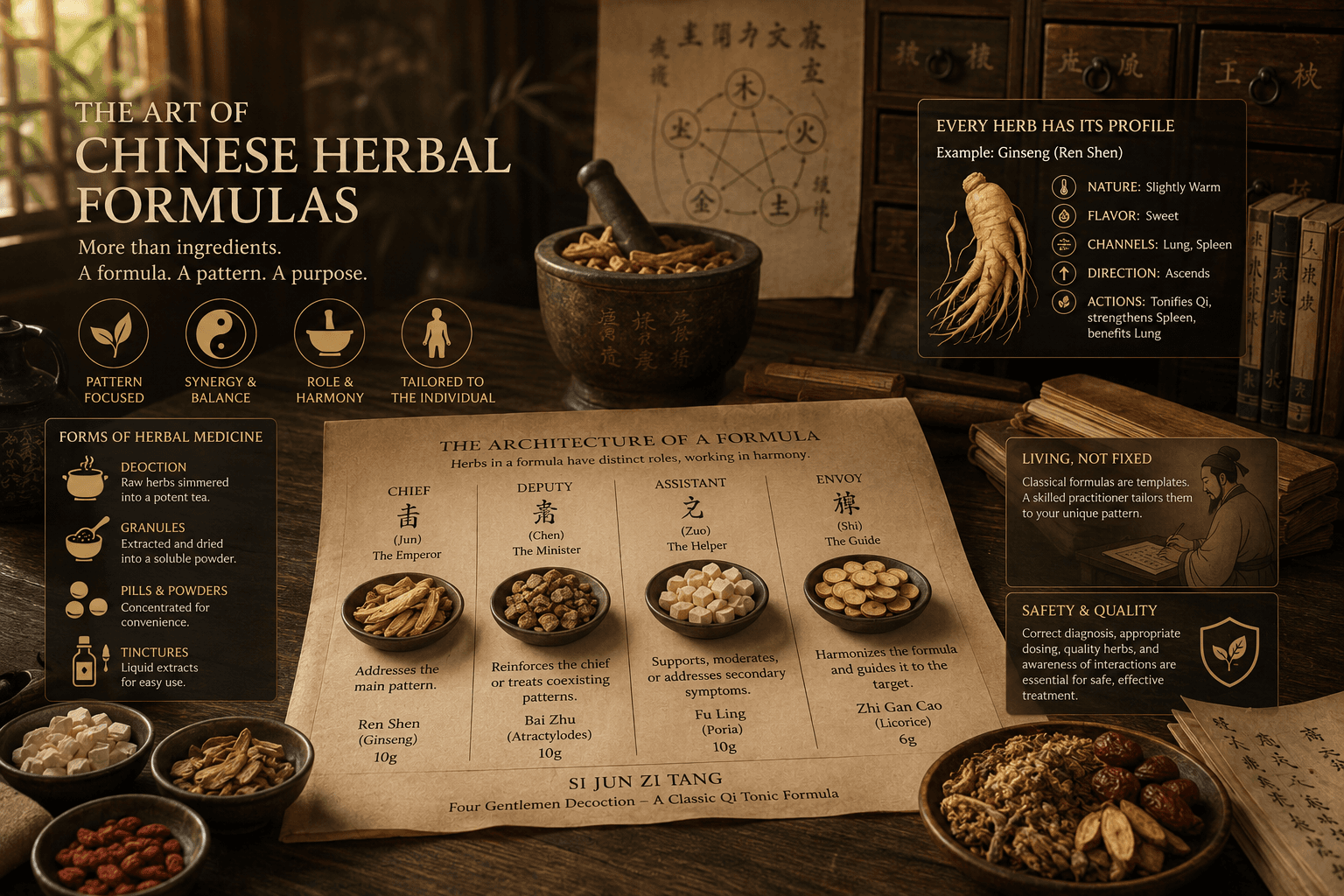
Ginseng (Ren Shen), for example, is sweet and slightly warm, enters the Lung and Spleen channels, and powerfully tonifies the Qi — a profile that tells a practitioner exactly where and how it will act.
The Architecture of a Formula
Here is the heart of the art. Within a formula, herbs are not simply mixed; they are assigned roles, in a structure classically compared to a well-run imperial court:
- Chief (Jun, the "emperor") — the main herb or herbs that address the principal pattern. The formula is built around them.
- Deputy (Chen, the "minister") — reinforces the chief, or treats an important coexisting pattern.
- Assistant (Zuo) — supports the chief and deputy, moderates their harshness or toxicity, or handles secondary symptoms.
- Envoy (Shi) — harmonizes the whole formula and guides its action to the target channel.
Consider Si Jun Zi Tang, the "Four Gentlemen Decoction," a foundational Qi tonic. Ginseng (Ren Shen) is the chief, tonifying the Qi. Atractylodes (Bai Zhu) is the deputy, strengthening the Spleen and drying dampness. Poria (Fu Ling) is the assistant, draining dampness so the tonic does not become cloying. And honey-fried Licorice (Zhi Gan Cao) is the envoy, harmonizing the others and supporting the middle. Four herbs, four roles, one coherent purpose.
Why Combine? Synergy and Safety
Combining herbs does far more than add effects together. Herbs modify one another: one can enhance another's desired action, curb its side effects, extend its reach to more channels, or balance its temperature. This lets a single formula match a whole pattern at once — for instance, to tonify Qi, gently move it, and protect the digestion that must absorb it — and it makes the medicine both safer and more precise than a single strong herb used alone.
Formulas Are Living, Not Fixed
A crucial point often missed: classical formulas are templates, not rigid recipes. A skilled practitioner starts from a base formula that matches the patient's core pattern, then modifies it — adding an herb for a particular symptom, removing one that does not fit, adjusting doses to shift the emphasis. This tailoring is exactly what separates prescribed Chinese herbal medicine from a fixed, one-size-fits-all product on a shelf.
Forms and Modern Use
Formulas reach the patient in several forms. The traditional decoction — raw herbs simmered into a strong tea — is the most flexible and potent, and the easiest to customize. Concentrated granules, made by extracting herbs and drying the liquid into a soluble powder, are convenient and widely used today. Herbs also come as pills, powders, and tinctures, each trading some flexibility for convenience.
Safety and Quality
Chinese herbs are genuine medicines, and they deserve the respect medicines require. Their safe use depends on a correct pattern diagnosis, appropriate dosing, well-sourced and properly identified herbs, and awareness of possible interactions with pharmaceutical drugs. For anything beyond simple food-grade remedies, herbal medicine is best used under the guidance of a qualified practitioner.
Why It Matters
Once you see the logic of the formula, "Chinese herbs" stops looking like a shelf of separate remedies and reveals itself as a compositional system — the same pattern-first thinking that runs through the rest of Chinese medicine, now expressed in plants. The nature and flavor of each herb, the roles within a formula, the tailoring to the individual: all of it serves the one goal that unites the whole medicine — restoring balance to a specific person with a specific pattern. Our knowledge base of individual herbs and classical formulas is the natural next place to explore how that logic plays out in practice.