For nearly two thousand years, Chinese physicians have looked at the tongue as one of the clearest windows into the interior of the body. If the pulse is what a practitioner feels, the tongue is what they see — and because its appearance changes slowly and steadily, it offers something the pulse cannot: a stable, visible record of the body's inner state.
Why the Tongue Reveals So Much
The tongue is densely supplied with blood vessels and linked, through the channel (meridian) system, to the internal organs — especially the Spleen and Stomach, which "open" onto it. Two things make it uniquely useful. First, it reflects both the substance of the body (the color of its flesh shows the state of Qi and Blood) and the activity of digestion (the coating shows the state of the Stomach and the presence of pathogenic factors). Second, it does not react to the moment: a cup of coffee or a stressful phone call changes the pulse instantly, but the tongue shifts over days and weeks. That makes it an anchor for tracking chronic conditions and the progress of treatment.
The Body of the Tongue
The tongue body is the muscle itself. Its color and shape speak to the deeper, longer-standing state of Qi, Blood, and the organs.
Color:
- Pale — deficiency of Qi or Blood, or internal cold. The paler the tongue, the more depleted or cold the picture.
- Red — heat; a bright red tongue suggests an active heat pattern.
- Deep red (crimson) — heat that has penetrated deeper, into the level of the Blood and Ying.
- Purple — stagnation. A bluish-purple cast leans toward cold and Blood stasis; purple-red toward heat with stasis.
Shape:
- Swollen or enlarged — often dampness or Spleen Qi deficiency; teeth marks along the edges (a "scalloped" tongue) reinforce this.
- Thin — deficiency of Blood or fluids.
- Cracks or fissures — depletion of fluids or Yin, especially when the cracks are deep and the tongue is red.
- Stiff, quivering, or deviated — internal Wind or a more serious disturbance.
The Coating
The coating is the thin film on the surface, produced by the "steaming" action of the Stomach on food. Where the tongue body reflects the deeper level, the coating reflects the more superficial, active layer — the state of the Stomach and Spleen and the presence of a pathogen.
- Color — a thin white coating is normal; a thick white coating suggests cold or dampness; yellow suggests heat; grey or black indicates either extreme heat or extreme cold, depending on whether it is dry or wet.
- Thickness — a thicker coating means a stronger or more inward pathogenic factor; a coating that thins over the course of treatment is a good sign.
- Moisture — a dry coating points to heat or depleted fluids; an excessively wet, slippery coating points to dampness or cold.
- Texture — a greasy coating, like a film of oil, indicates dampness or phlegm; a "rootless" or peeled coating that looks painted on and wipes away easily suggests weakened Stomach Qi or depleted Yin.
An important principle: a coating with a "root," seeming to grow from the tongue, reflects a body that still holds Stomach Qi; a rootless coating warns that the foundation is weakening — even when the surface still looks coated.
A Map on the Surface
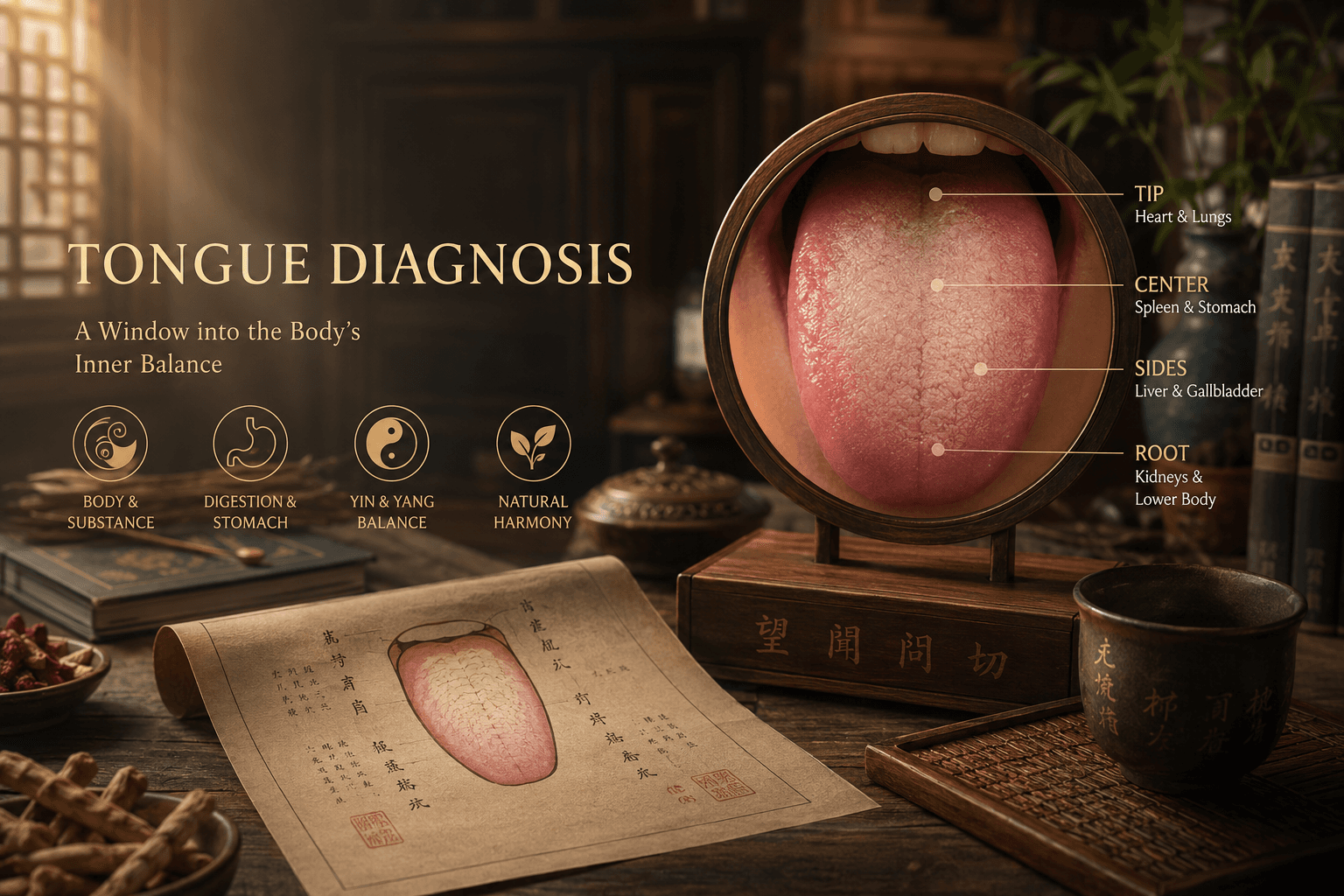
Different regions of the tongue correspond to different organ systems, so where a change appears matters as much as what it is:
- Tip — the Heart and Lungs. A red tip often points to Heart heat and may accompany insomnia or anxiety.
- Center — the Spleen and Stomach; a thick coating here reflects the state of digestion.
- Sides (edges) — the Liver and Gallbladder; red or swollen edges suggest Liver heat or constraint.
- Root (back) — the Kidneys and the lower body.
Practitioners also lift the tongue to inspect the veins underneath: dark, distended sublingual veins are a classic sign of Blood stasis.
What a Healthy Tongue Looks Like
A balanced tongue is pale red — neither too pale nor too dark — of normal size and shape, moist but not wet, with a thin, even, white coating that has a root. Diagnosis is the art of reading deviations from this baseline, never a single feature in isolation.
Reading Signs Together
No feature is diagnostic on its own. A pale, swollen tongue with a thick, wet white coating tells a story of cold and dampness with Spleen deficiency; a red, cracked tongue with little or no coating tells the opposite story of heat consuming the fluids and Yin. The practitioner weaves the tongue together with the pulse, the patient's symptoms, and their history — the "four examinations" of Chinese medicine — which is exactly why diagnosis here is a craft, not a checklist.
A Practical Caution
The tongue can be misread if you don't account for what alters it: coffee, tea, beetroot, and colored sweets can stain the coating; scraping or brushing removes it; and mouth-breathing dries it out. Practitioners examine the tongue in natural light, early in a visit, and ask about recent food and habits before drawing conclusions.
Try It Yourself
Look at your own tongue each morning, before eating or brushing, in natural light. Notice its color, whether it is swollen or thin, whether it carries cracks or teeth marks, and the color and thickness of its coating. Over weeks you will begin to see it shift with your sleep, stress, and diet — a small daily window into your own internal balance, and often the first sign that something is changing before you feel it.