When a practitioner of Traditional Chinese Medicine (TCM) says "Liver" or "Kidney," they do not mean only the physical organ on an anatomy chart. Each organ name refers to an entire functional system — a set of physiological and psychological roles, a network of tissues, a governing emotion, and a characteristic direction of Qi. The Western liver and the TCM Liver overlap, but they are not the same thing. By convention, the capitalized name (Liver, Spleen) marks the TCM system rather than the anatomical organ.
Organs as Functions, Not Just Structures
This is one of the deepest differences between Chinese and Western medicine. Western anatomy asks what an organ is made of and where it sits. TCM asks what an organ does — how it moves Qi, which substance it stores, which tissue it nourishes, which emotion it colors. An organ, in this view, is less a lump of tissue than a job description. This is why a single "Liver" pattern can connect the eyes, the tendons, the menstrual cycle, and a person's irritability — all of which fall under the Liver's work.
Zang and Fu: Two Families of Organs
TCM sorts the organs into two families with opposite characters:
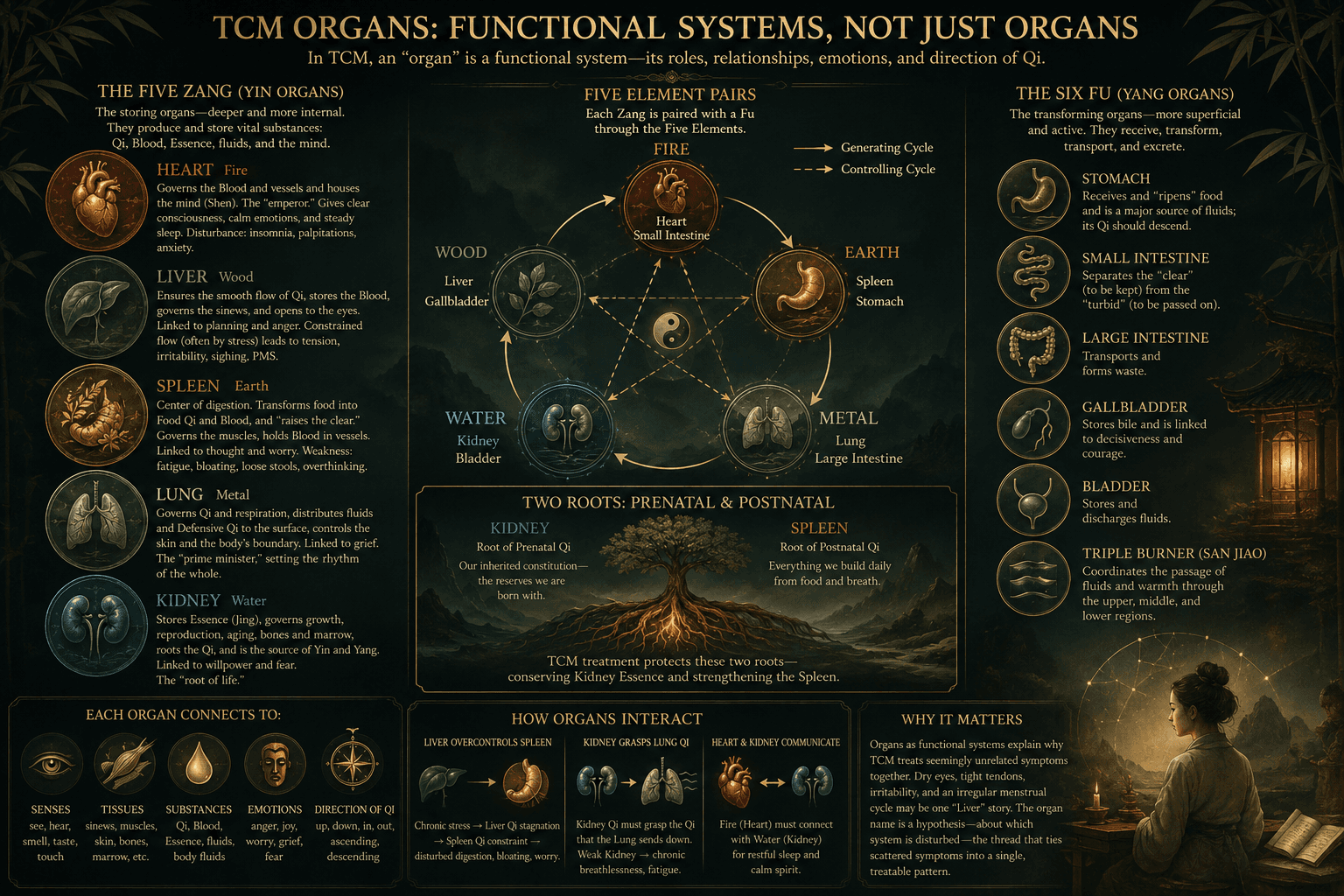
- The five Zang (yin organs) — Heart, Liver, Spleen, Lung, and Kidney. These are the solid, "storing" organs. Their job is to produce and store the vital substances — Qi, Blood, Essence, fluids, and the mind. They are deeper and considered more important.
- The six Fu (yang organs) — Stomach, Small Intestine, Large Intestine, Gallbladder, Bladder, and the Triple Burner. These are the hollow, "transforming" organs. Their job is to receive, break down, transport, and excrete food and waste. They are more superficial and more active.
Each Zang is paired with a Fu through the Five Elements — Liver with Gallbladder (Wood), Heart with Small Intestine (Fire), Spleen with Stomach (Earth), Lung with Large Intestine (Metal), Kidney with Bladder (Water).
The Five Zang — the Heart of the System
- Heart — governs the Blood and the vessels and houses the mind (Shen). The classics call it "the emperor." A healthy Heart gives clear consciousness, calm emotions, and steady sleep; disturbance shows as insomnia, palpitations, and anxiety.
- Liver — ensures the smooth, free flow of Qi throughout the whole body, stores the Blood, governs the sinews, and opens to the eyes. It is linked to planning and the emotion of anger. When its flow is constrained — often by stress — the result is tension, irritability, sighing, and premenstrual tension.
- Spleen — the center of digestion. It transforms food into Food Qi and Blood and "raises the clear," lifting nourishment upward. It governs the muscles and holds the Blood in the vessels, and it is linked to thought and worry. A weak Spleen brings fatigue, bloating, loose stools, and overthinking.
- Lung — governs Qi and respiration, distributes the fluids and the Defensive Qi to the surface, and controls the skin and the body's boundary. It is linked to grief. The classics call it "the prime minister," setting the rhythm of the whole.
- Kidney — stores the Essence (Jing), governs growth, reproduction, and aging, roots the Qi (helping the Lung grasp the breath), and governs the bones and marrow. It is the source of the body's deepest Yin and Yang, linked to willpower and the emotion of fear. It is called "the root of life."
The Six Fu — the Workshop
- Stomach — receives and "ripens" food and is a major source of fluids; its Qi should descend.
- Small Intestine — separates the "clear" (to be kept) from the "turbid" (to be passed on).
- Large Intestine — transports and forms waste.
- Gallbladder — stores bile and is linked to decisiveness and courage.
- Bladder — stores and discharges fluids.
- Triple Burner (San Jiao) — not a discrete organ but the system that coordinates the passage of fluids and warmth through the upper, middle, and lower regions of the body.
Two Roots: Prenatal and Postnatal
Among the Zang, two stand out as the body's foundations. The Kidney is the "root of prenatal Qi" — the inherited constitution you are born with. The Spleen is the "root of postnatal Qi" — everything you build daily from food and breath. A great deal of TCM treatment comes down to protecting these two roots: conserving the Kidney's reserves and keeping the Spleen strong.
How the Organs Interact
Because organs are defined by their roles, they are also defined by their relationships. The Liver can "overcontrol" the Spleen, so chronic stress disturbs digestion. The Kidney must "grasp" the Qi that the Lung sends down, so weak Kidneys can cause chronic breathlessness. The Heart (Fire, above) and the Kidney (Water, below) must "communicate" for restful sleep. A TCM diagnosis reads the pattern across organs, never one organ in isolation.
Why It Matters
Seeing the organs as functional systems explains one of TCM's most distinctive habits: treating seemingly unrelated symptoms together. Dry eyes, tight tendons, irritability, and an irregular menstrual cycle may look like four different problems to Western eyes, but to a TCM practitioner they can be a single "Liver" story. The organ name is really a hypothesis — a claim about which system is disturbed — and it is the thread that ties scattered symptoms into a single, treatable pattern.