Acupuncture points get most of the attention, but they only make sense as part of something larger: the meridian system, the network the points sit on. Without the channels, a point is just a spot on the skin. With them, it becomes a doorway into a system that links the surface to the organs and one end of the body to the other. Understanding the meridians is what turns acupuncture from a collection of spots into a coherent map.
What the Meridians Are
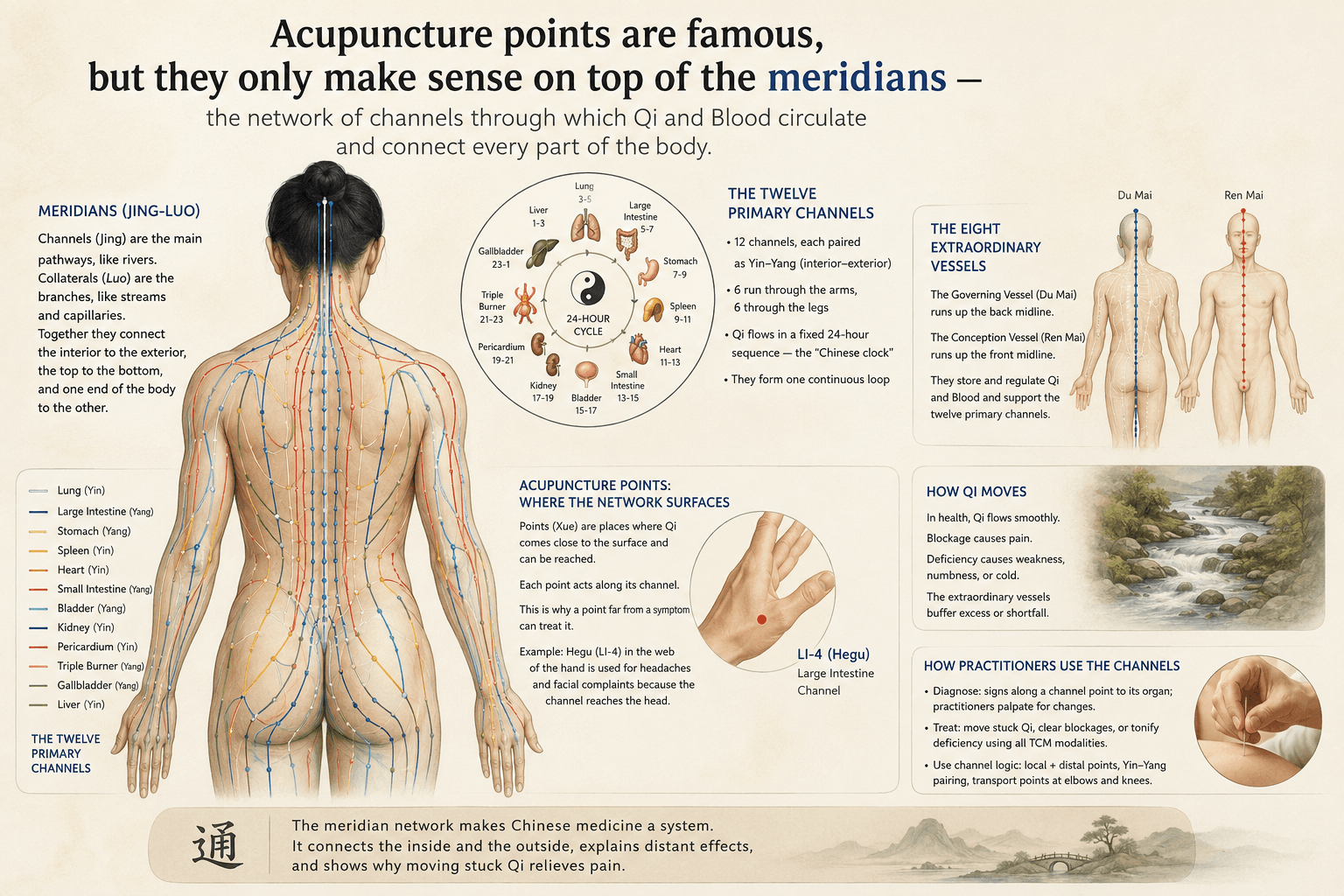
In Chinese, the system is called the Jing-Luo — the channels (Jing) and collaterals (Luo). It is the network through which Qi and Blood circulate, connecting the internal organs to the body surface, the interior to the exterior, and the top of the body to the bottom. The meridians are not blood vessels and not nerves; they are best understood as a functional map of connection. They are the reason a point on the foot can influence the head, and why a disorder of an internal organ can show up as a sign along a line on the arm.
Channels and Collaterals
The network has two scales. The channels (Jing) are the main, deeper pathways that run longitudinally through the body, like rivers. The collaterals (Luo) are the smaller branches that spread out from the channels, weaving a progressively finer net that reaches every tissue, like streams and capillaries branching from the rivers. Together they leave no part of the body unconnected.
The Twelve Primary Channels
At the core of the system are twelve primary channels, each associated with one of the twelve organs and named for it — the Lung channel, the Stomach channel, the Liver channel, and so on. They are organized by a clear logic:
- Each channel belongs to a Yin organ (a Zang) or a Yang organ (a Fu), and the Yin and Yang channels are paired — interior with exterior.
- Six channels run mainly through the arms and six through the legs, with Yin channels on the inner surfaces and Yang channels on the outer surfaces.
- The twelve form one continuous loop. Qi flows from one channel into the next in a fixed twenty-four-hour sequence — the "Chinese clock" — beginning with the Lung and passing through the Large Intestine, Stomach, Spleen, and onward, ending with the Liver, which hands back to the Lung.
The Eight Extraordinary Vessels
Beyond the twelve lie eight "extraordinary" vessels, which behave differently. The two most important are the Governing Vessel (Du Mai), which runs up the midline of the back and spine, and the Conception Vessel (Ren Mai), which runs up the midline of the front. Rather than belonging to a single organ, the extraordinary vessels act as reservoirs: they store surplus Qi and Blood and release it to keep the twelve primary channels in balance. They are also deeply tied to the Essence (Jing) and the constitution. The Du and Ren are the most used, because — unlike the other six — they carry their own acupuncture points.
Acupuncture Points: Where the Network Surfaces
Acupuncture points (Xue) are specific locations along the channels where the Qi comes close to the surface and can be reached — with a needle, with pressure, or with the warmth of moxibustion. Each point has its own actions, determined by the channel it lies on and its position along it. This is precisely why a point far from a symptom can treat it: the point acts along the entire course of its channel. The famous point Hegu (LI-4), in the web of the hand, is a classic example — it is used for complaints of the face and head because its channel travels all the way there.
How Qi Moves Through the Network
In health, Qi flows smoothly and continuously through the twelve channels in sequence, with the extraordinary vessels buffering any excess or shortfall. Disease appears when this flow is disturbed. A blockage in a channel causes pain — captured in the classic saying, "where there is free flow, there is no pain; where there is pain, there is no free flow." Deficiency along a channel, by contrast, brings weakness, numbness, or cold to the area it supplies.
How Practitioners Use the Channels
The meridians serve both diagnosis and treatment. In diagnosis, pain or other signs along a channel point back to its associated organ, and practitioners palpate the channels and points for tenderness or change. In treatment, every hands-on TCM technique — needling, acupressure, moxibustion, cupping, gua sha — works on the channels to move stuck Qi, clear blockages, or strengthen what is deficient. Point selection follows channel logic: combining a local point near the problem with a distal point far along the same channel, linking a channel with its Yin–Yang partner, or using the classified "transport points" near the elbows and knees.
Why It Matters
The meridian network is what makes Chinese medicine a system rather than a list of remedies. It explains how the inside of the body connects to the outside, why a needle in the hand can ease a headache, and why moving stuck Qi relieves pain. Every needle, every press of the thumb, every cup placed on the back is, in the end, a way of speaking to this single living network.