Yin and Yang: Not Just a Spiritual Symbol, but the Body's Operating System
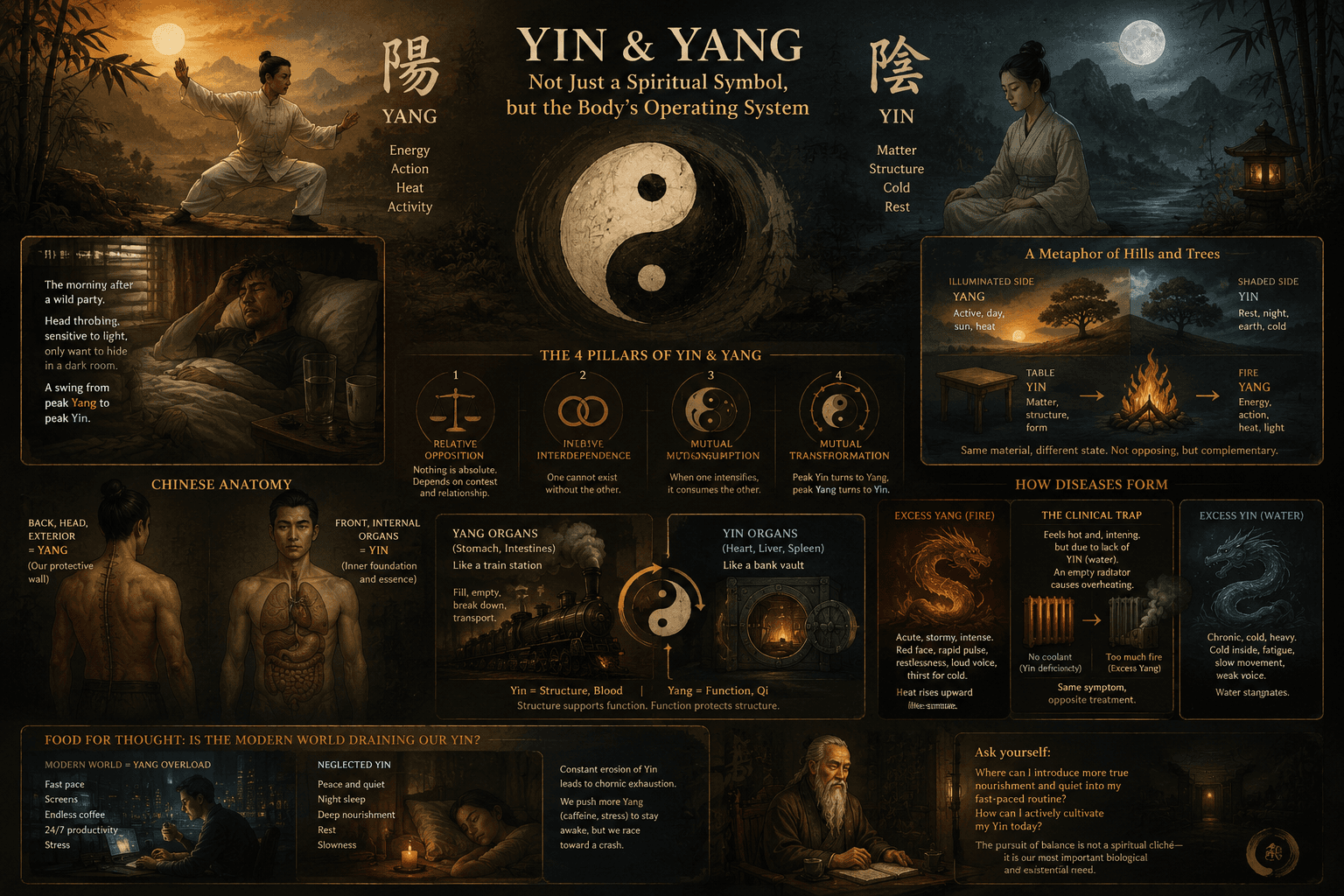
Imagine the morning after a particularly wild party. Your head throbs with an indescribable ache, there's a terrible sensitivity to every tiny ray of light piercing through the blinds, and your only desire is to simply hide in a dark room, crawl under a thick blanket, and not move for days.
Most of us are familiar with this feeling of physical collapse. But what might be hard to believe is that ancient Chinese philosophers could look at this specific misery and use it to explain exactly how the entire universe—and our bodies—work.
When we hear the words "Yin and Yang," it’s easy to picture the familiar symbol of the circle divided into black and white, the one that appears as a tattoo or a logo on a yoga studio door. Many tend to attribute a mystical aura of "spiritual harmony" to these concepts, but in fact, beneath the popular graphics lies a genuine conceptual technology. It is the "operating system" of Chinese medicine—a precise clinical model that explains why the body breaks down, how diseases form, and how they can be healed.
A Metaphor of Hills and Trees: What Are Yin and Yang Really?
To deeply understand these concepts, we must return to the observations of the Naturalist School in ancient China. Unlike Western science, which sought to deconstruct nature to control it, the Chinese sages sought to understand the laws of nature in order to flow with them, understanding that fighting nature is a surefire recipe for disease.
Their most basic observation was the structure of a hill. The illuminated side, the one that absorbs the sun's heat, is active, and associated with the day—is the Yang. The shaded, dark, and cold side, associated with the earth and rest—is the Yin.
But the real cognitive leap is the realization that this is not just about light and shadow, but about states of matter and energy:
Imagine a massive wooden table. It is dense, heavy, and has a clear shape in space. This is Yin (matter and structure).
Now, imagine chopping that table into pieces and throwing it into a bonfire. The energy is released, and heat and light radiate through the room. This is Yang (energy and action).
It is exactly the same material, but it has changed its physical state. Energy and matter do not contradict each other; rather, they complement each other in one continuous spectrum.
The 4 Pillars: How Does This Dance Play Out in Our Bodies?
Instead of a "struggle" where one cancels the other out, Yin and Yang maintain a constant dance within our bodies, based on four ironclad rules:
Relative Opposition: Nothing is absolute. For example, chicken meat is considered "Yang" (warming) compared to a bowl of lettuce, but it would be considered "Yin" (cooling) if served alongside lamb, which is much hotter and more stimulating. In the clinic, this means that treatment is always tailored to the unique relationship within the patient at a given moment.
Interdependence: One cannot exist without the other. As written in the Dao De Jing: "In order to contract, one must first expand." Rest (Yin) has no meaning if it wasn't preceded by activity (Yang). A person lying in bed for two weeks isn't resting; they are degenerating.
Mutual Consumption: Because they rely on each other, the balance between them is never static. If one force intensifies, it will consume the other. Think of an extreme heatwave in the summer (excess Yang) that evaporates the water and dries out the earth (consuming the Yin).
Mutual Transformation: Peak Yin will turn into Yang, and peak Yang will turn into Yin. This brings us back to the hangover example: at the party, the person is at the peak of activity, alcohol consumption, and bursting energy (peak Yang). When the pendulum swings to the edge, the crash is inevitable, and the body suddenly becomes exhausted, demanding darkness and absolute rest (peak Yin). This mechanism keeps us alive and prevents our systems from burning out completely.
The Train Station vs. The Central Bank: Chinese Anatomy
When we map this theory onto human anatomy, we see a fascinating division. The back, the head, and the exterior parts of the body belong to Yang (our protective wall). The front and the deep internal organs belong to Yin.
This division continues within the organs themselves:
Yang Organs (like the stomach and intestines): Operate like a bustling train station. They fill, empty, break down goods, and transport them onward. It is a job of constant movement.
Yin Organs (like the heart, liver, and spleen): Operate like the most secure vault in a bank. Their role is not to transport waste, but to gather, protect, and store the purest essences of the body and the blood, hidden from sight.
And here, it is important to bust a myth: when we talk about "Qi", we don't mean a mystical magic force from the movies. Qi is simply the active function of the organ (Yang). Its physical structure and the blood it contains are the Yin. When the structure (Yin) is intact, it allows the organ to perform its function (Yang). When the function is efficient, it protects the structure.
A Burning Engine and an Empty Radiator: How Do Diseases Form?
Diseases begin to surface when this harmony is disrupted. In Chinese medicine, almost every clinical symptom can be classified under the behavior of fire (Yang) or water (Yin).
Excess Yang (Fire): Will manifest as an acute and stormy illness—red face, rapid pulse, restlessness, a loud voice, and a thirst for cold drinks. Heat rises upwards, just like smoke (migraines, burning eyes).
Excess Yin (Water): Will manifest as a slow and ongoing illness—a deep feeling of cold even on a hot day, heavy fatigue, slow movements, and a weak voice.
The Clinical Trap: Sometimes, the body feels hot and burning, but not because of an excess of fire, rather due to a lack of water (Yin deficiency). Imagine an engine overheating not because we pressed the gas pedal too hard (excess Yang), but simply because there is no coolant in the radiator (Yin deficiency). Outwardly, the hood is smoking in both cases, but the treatment must be the exact opposite. Giving cooling and draining herbs in such a state will simply siphon the few remaining resources the patient has left. This is exactly where the expertise of Chinese diagnostics comes in.
The proper physiological fire in our body, the one responsible for metabolism and digesting food (the flame under the pot), is called "Ming Men" (The Gate of Life) and originates in the kidneys. When this fire fades, the result isn't just digestive issues, but apathy, deep melancholy, and clinical depression.
Food for Thought: Is the Modern World Draining Our Yin?
The philosophy of Yin and Yang isn't reserved only for treatment rooms; it is a critical lens through which to examine our modern daily lives.
Western society is built to generate extreme fluctuations. It absolutely worships Yang: fast movement, flickering screens, endless coffee consumption, and a technological demand for 24/7 output and availability. In contrast, we neglect the Yin: peace of mind, continuous night sleep, and the deep, slow nourishment of the body.
This systemic erosion of Yin leads to chronic mass exhaustion. We try to push more and more "Yang" (caffeine, stress) into ourselves just to stay awake, but in reality, we are racing towards a violent crash.
The next time you face a stressful day, ask yourself honestly: Where can I introduce more true nourishment and quiet into my fast-paced routine? How can I actively cultivate my Yin today? Because the pursuit of balance is not a spiritual cliché—it is our most important biological and existential need.