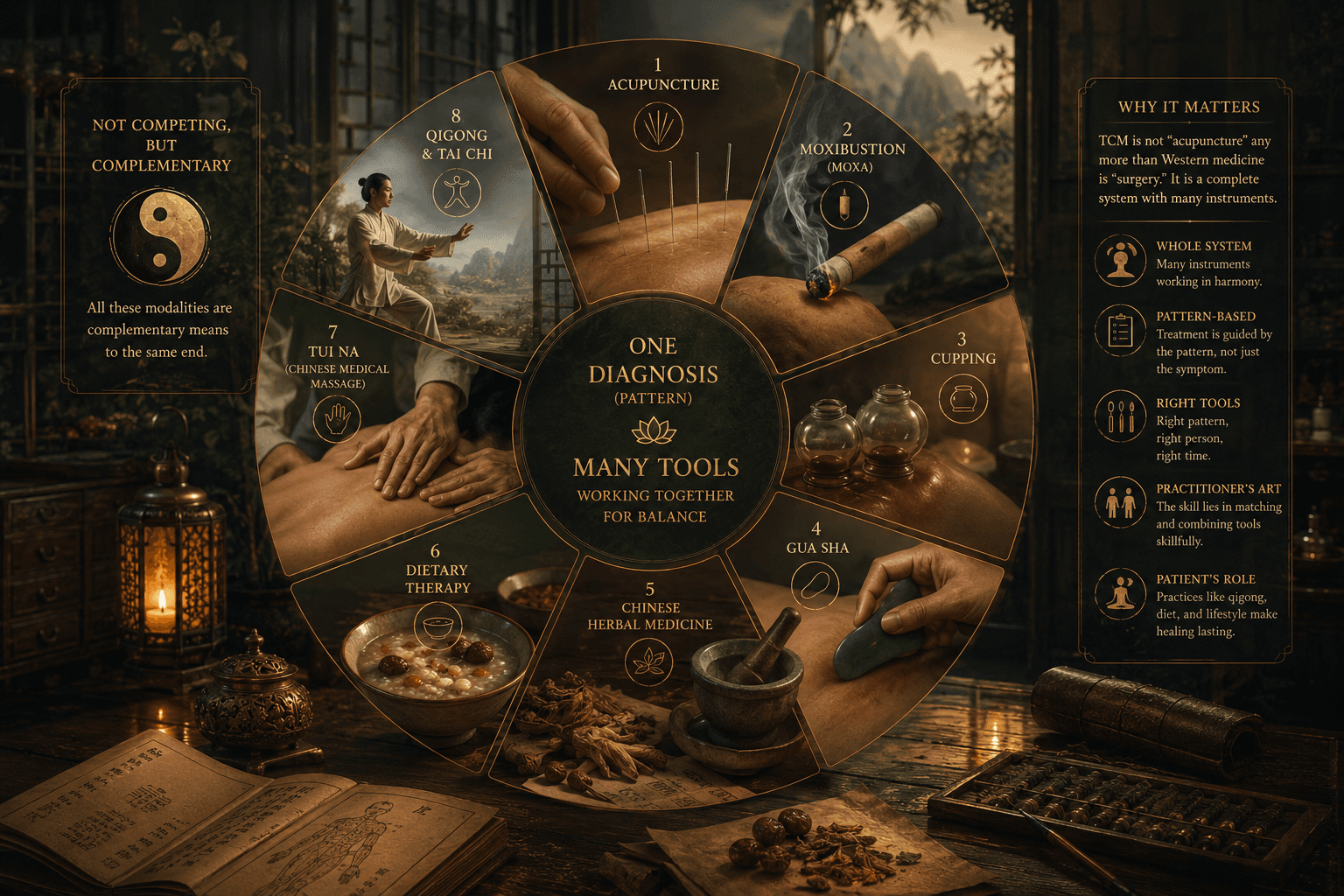
Most people meet Traditional Chinese Medicine (TCM) through acupuncture, but acupuncture is only one instrument in a much larger orchestra. TCM is a complete medical system with a family of therapies — needles, heat, suction, herbs, food, hands, and movement — all pursuing a single goal: restoring the smooth flow and balance of Qi, Blood, and the organs. Understanding the full toolkit shows why a good practitioner rarely relies on one method alone.
One Diagnosis, Many Tools
The starting point is always the same: the diagnosis of a pattern. Two people with the same headache may receive completely different treatment — one for Liver Qi rising, another for Blood deficiency — because the pattern, not the symptom, decides the strategy. Once the pattern is clear, the practitioner selects and combines the tools below to fit it. The modalities are not competing schools; they are complementary means to the same end.
Acupuncture
The best-known modality: fine, sterile, single-use needles are inserted at specific points along the channels to regulate the flow of Qi. Depending on how and where they are used, needles can move stagnation, tonify what is deficient, clear heat, or calm the mind. Patients often feel a characteristic dull, heavy, or tingling sensation at the point — called de qi, "the arrival of Qi" — which signals that the point has been engaged. Acupuncture is especially valued for pain, functional and stress-related disorders, and regulating the body's rhythms.
Moxibustion (Moxa)
Moxibustion is acupuncture's warming partner. Dried mugwort (Ai Ye) is burned near or on a point to introduce gentle, penetrating heat. Where needles regulate, moxa warms and tonifies — making it the treatment of choice for cold, deficiency, and weak Yang, from cold painful joints to fatigue and digestive weakness. It is so often paired with needling that the combination has its own name: acu-moxa.
Cupping
In cupping, rounded cups are applied to the skin and a vacuum is created inside them, drawing the skin and superficial tissue upward. This suction moves Qi and Blood, releases tight muscles, and clears stagnation and "wind-cold" lodged at the surface. The round marks it can leave are not bruises from injury but stagnation drawn up and out; they fade over days. Cupping is widely used for tension, pain, and the early stages of a cold.
Gua Sha
Gua sha ("scraping sha") uses a smooth-edged tool to stroke lubricated skin in one direction. The technique releases heat and stagnation and promotes circulation, raising a temporary red speckling called sha that reflects the stagnation being cleared. It is a favorite for muscular pain and stiffness, tension, and the onset of colds and fevers.
Chinese Herbal Medicine
Alongside acupuncture, herbal medicine is the second great pillar of TCM — and often the more powerful for internal and chronic conditions. Its defining feature is that herbs are almost never used alone but combined into formulas, each built to a pattern. Within a formula the ingredients take roles — a chief herb that addresses the main pattern, deputies that reinforce it, assistants that moderate or treat secondary issues, and an envoy that harmonizes and directs the whole. Formulas come as traditional decoctions, concentrated granules, pills, and powders.
Dietary Therapy
Chinese medicine has always treated food as the first medicine. Foods are classified by their thermal nature (warming or cooling) and their flavor, and are matched to the patient's pattern: warming, easily digested food for a cold, weak digestion; cooling, moistening food for heat and dryness. Because it centers on protecting the Spleen and Stomach — the root of postnatal Qi — dietary therapy is the everyday, preventive layer of TCM that a patient practices at every meal.
Tui Na (Chinese Medical Massage)
Tui Na — literally "push-grasp" — is hands-on therapy that works the channels and points through pressing, kneading, rolling, and stretching. Sitting somewhere between massage and physiotherapy, it treats musculoskeletal complaints directly and can influence the internal organs through the channel system, making it a versatile option for those who prefer not to use needles.
Qigong and Tai Chi
The final tools belong to the patient. Qigong and Tai Chi are practices of self-cultivation that coordinate slow movement, breath, and attention to circulate Qi and strengthen the body from within. Unlike the other modalities, they are done by the patient rather than to them — which makes them the heart of TCM's approach to prevention and long-term balance.
How They Work Together
A skilled practitioner rarely picks just one tool; they compose. A pattern of Liver Qi stagnation might call for acupuncture to move the Qi, a formula of moving herbs, and qigong to sustain the effect between visits. A cold, deficient pattern might call for moxa, warming herbs, and dietary changes. However they are combined, all of these methods aim at the same destination — free flow where there is stagnation, warmth where there is cold, strength where there is deficiency, and calm where there is disturbance.
Why It Matters
Seeing the whole toolkit corrects a common misunderstanding: TCM is not "acupuncture" any more than Western medicine is "surgery." It is a complete system with many instruments, and its art lies in matching the right tools to the right pattern in the right person. The needles get the attention, but it is the coherence behind them — one diagnosis directing many therapies — that makes Chinese medicine a medicine.