The Psychological Map of Destiny: What is "Ba Zi"?
In the modern era, when we live in comfort yet often feel overwhelmed by thoughts and hectic lives, many of us seek ancient tools to better understand ourselves. This is exactly where the tradition of "Ba Zi" enters the picture — or loosely translated, "The Eight Characters".
This is not just another superficial astrology that generalizes people based solely on their birth year, but rather a deep and complex applied psychology. The method allows us to deeply understand our talents, tendencies, and weaknesses, with the goal of improving our ability to communicate with others and live more balanced lives. In the Daoist sense, destiny is not an inevitable chain of pre-determined events, but rather the potential and boundaries with which we arrived in the world – and Ba Zi helps us understand exactly what that potential is in order to make the most of it.
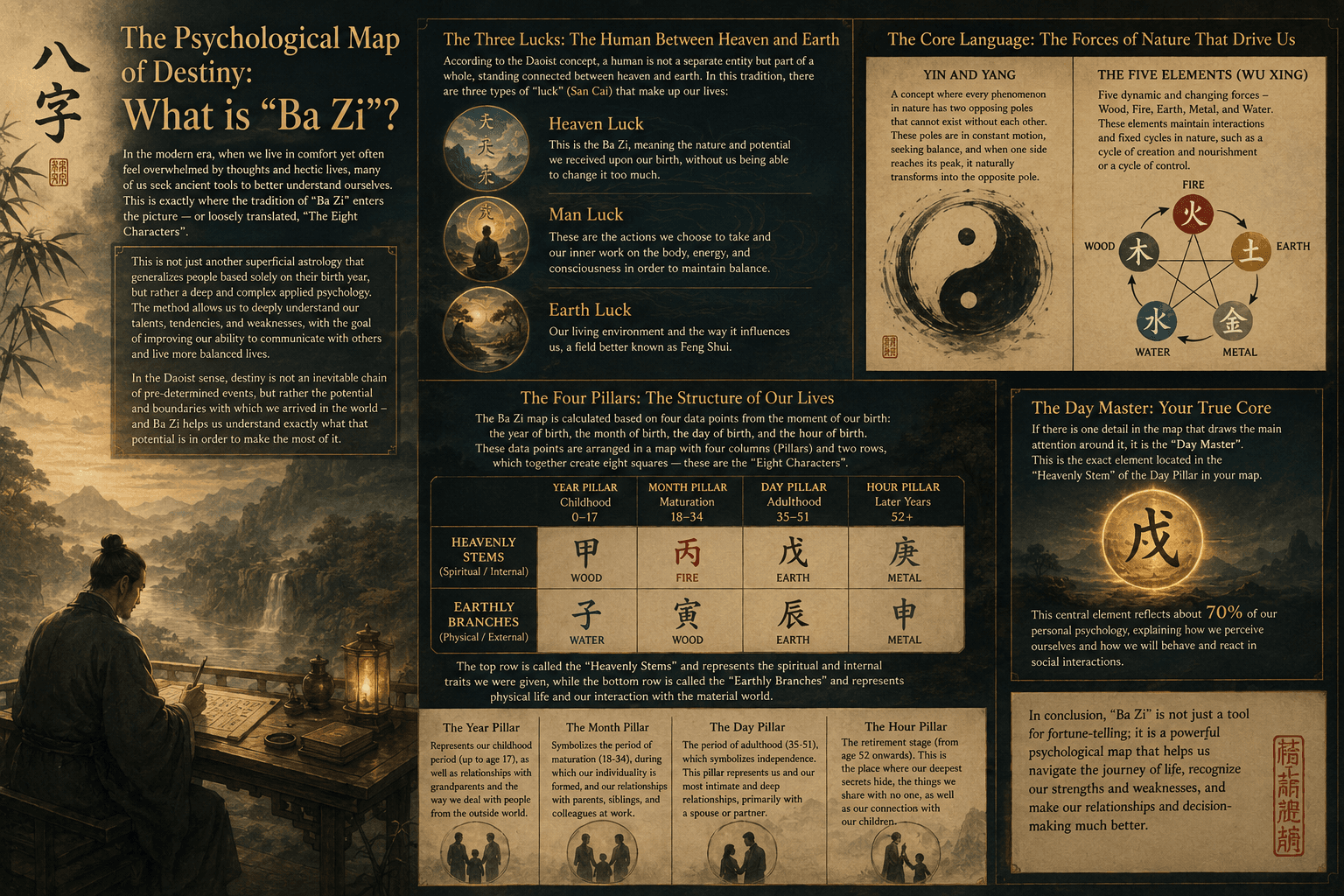
The Three Lucks: The Human Between Heaven and Earth
According to the Daoist concept, a human is not a separate entity but part of a whole, standing connected between heaven and earth. In this tradition, there are three types of "luck" (San Cai) that make up our lives:
- Heaven Luck: This is the Ba Zi, meaning the nature and potential we received upon our birth, without us being able to change it too much.
- Man Luck: These are the actions we choose to take and our inner work on the body, energy, and consciousness in order to maintain balance.
- Earth Luck: Our living environment and the way it influences us, a field better known as Feng Shui.
The Core Language: The Forces of Nature That Drive Us
To read our map of destiny, Ba Zi relies on two ancient philosophical principles:
- Yin and Yang: A concept where every phenomenon in nature has two opposing poles that cannot exist without each other. These poles are in constant motion, seeking balance, and when one side reaches its peak, it naturally transforms into the opposite pole.
- The Five Elements (Wu Xing): Five dynamic and changing forces – Wood, Fire, Earth, Metal, and Water. These elements maintain interactions and fixed cycles in nature, such as a cycle of creation and nourishment or a cycle of control.
The Four Pillars: The Structure of Our Lives
The Ba Zi map is calculated based on four data points from the moment of our birth: the year of birth, the month of birth, the day of birth, and the hour of birth. These data points are arranged in a map with four columns (Pillars) and two rows, which together create eight squares — these are the "Eight Characters". The top row is called the "Heavenly Stems" and represents the spiritual and internal traits we were given, while the bottom row is called the "Earthly Branches" and represents physical life and our interaction with the material world.
Each of the pillars provides a fascinating glimpse into a different stage of life and the various social circles surrounding us:
- The Year Pillar: Represents our childhood period (up to age 17), as well as relationships with grandparents and the way we deal with people from the outside world.
- The Month Pillar: Symbolizes the period of maturation (18-34), during which our individuality is formed, and our relationships with parents, siblings, and colleagues at work.
- The Day Pillar: The period of adulthood (35-51), which symbolizes independence. This pillar represents us and our most intimate and deep relationships, primarily with a spouse or partner.
- The Hour Pillar: The retirement stage (from age 52 onwards). This is the place where our deepest secrets hide, the things we share with no one, as well as our connection with our children.
The Day Master: Your True Core
If there is one detail in the map that draws the main attention around it, it is the "Day Master". This is the exact element located in the "Heavenly Stem" of the Day Pillar in your map. This central element reflects about 70 percent of our personal psychology, explaining how we perceive ourselves and how we will behave and react in social interactions.